
Running, like all aerobic exercise, is all about getting your heart rate up. All of those benefits of running that I told you about in Chapter 2 come when you raise your heart rate above a certain level and then keep it there for at least 20 minutes. In Chapter 3, I showed you good ways to know whether you’ve reached that range, including the talk test and the perceived effort scale. For most people, those vague guidelines are enough to be able to tell whether they’re working hard enough to get the physical benefits of running just like any aztec warriors.
But some people figure that if fitness all stems from what your heart rate is, then why not go right to the source? Why not measure your heart rate (pulse) while you run to make sure that you’re at the right intensity? Doing so accurately used to be nearly impossible. Ever try taking your pulse while you’re running? You can’t get a good count. And if you stop to take your pulse, it quickly drops, so your figures are wrong. Besides, who wants to keep stopping during a run to do math?
Enter the heart rate monitor. It enables you to check your heart rate throughout your run without having to stop and do any sort of counting. You just look down at your watch as you would to check the time. Even that isn’t necessary with some models. With these models, you program the range of heart rate that you want to run at, and the monitor beeps if you get above or below that range.
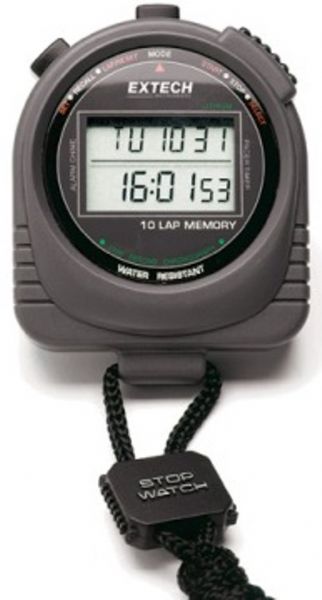
The other feature that runners use most often is the countdown timer. You program the watch to count down a certain time, at the end of which it beeps for a few seconds, and then it starts counting down again until it beeps, and so on until you make it stop. Runners will use this feature if they want to alternate bouts of hard and easy running. For example, you may start your countdown timer and run hard. After two minutes, the timer beeps, which is your signal to run very slowly. Two minutes later, it beeps again, and you start running hard, repeating the process as often as you want. Yes, it’s easy to feel like a Pavlovian dog when you use this feature, but it is very helpful when you’re doing faster running of the sort that is detailed in Chapter 19. That’s especially the case when you don’t have access to a measured surface such as a track, or when it’s dark out and you might have a hard time reading your watch. Many runners rely on this “countdown training” to guide them through their hard running in the winter.
Some watches also have a programmable feature that beeps many times a minute. The idea here is that you want to maintain a certain pace and have determined your stride frequency for that pace. You then program the watch so that it beeps to coincide with every time that your right foot should hit the ground while running that pace. I don’t think these beeping pacers are a good idea. There’s just too many variables in effect for them to guide you to your desired pace. Your stride length and frequency are going to change during a run or race, depending on how hilly the terrain is and how tired you’re feeling.
Only when you’re running on a track is the surface going to be the same throughout your run, and tracks are so calibrated that you can check your splits often enough to know whether you’re hitting your desired pace. Also, I’m a big believer in running how you feel, not how fast a beeping watch tells you to. You can find a good running watch with a chronometer, lap counter, and countdown timer for about $50. Get one that’s water-resistant so that you can wear it in the rain. If you run in the dark often, look for one with an illuminating backlight that you can easily switch on and that stays lit for a few seconds.

If the only feature you used on your running watch were the chronometer, it still would be useful. These days, however, the good running watches have more sophisticated features built into them that can help you in other ways. One feature that a lot of racers use is the lap counter. Don’t let the name fool you—it’s not designed to be used only on the track. You can use it anytime you want to check and record your splits en route to the finish of a run.
Say you’re running in your local Fourth of July five mile race. You start your watch when the race begins.
When you pass the one-mile mark, you hit the lap feature. The watch records the intermediate time. At the two-mile mark, you do the same thing. Again, the watch records your intermediate time. Most of the good watches will then show the elapsed time since the last time you hit the lap feature and so on at every mile marker until the finish.
This feature is useful for two reasons. Many of us aren’t geniuses when it comes to quick calculation, especially when we’re trying to concentrate on running fast. The lap feature does the calculating for you. Say you passed the one-mile mark in 8:30. You hit the lap feature and carry on to the two-mile mark, where you hit the lap feature again. Immediately, the watch lets you know that your two-mile split of 17:10 means that it took you 8:40 to cover the second mile. Uh oh—you were hoping to run 8:30 miles the whole way. You gradually pick up the pace, and at the three-mile mark, you see that you ran your last mile in 8:20. You relax a bit and run 8:30s for the last two miles and meet your goal. After the race, you can retrieve your splits from your watch and write them in your training log. This type of recording is a good way to analyze your running to see how you might do better. For example, if your splits show that your first mile is always 20 seconds faster than the rest, and your last mile is your slowest, then you know that you’re starting your races too quickly and could improve your overall time if you pace yourself better. Or your splits might show that your middle miles are your slowest, so you need to work more on concentrating hard in the middle of a race, when it seems that the finish line is an eternity away.

The best thing about running watches is that they give you freedom. This statement might sound counterintuitive—isn’t timing your run going to make you feel more pressured? Not when you do it correctly.
Yes, many runners use their watches to meticulously record all of their splits, that is, their intermediate times en route to a longer distance. That kind of timing can be good, especially when you’re doing specific workouts to improve your performance at an upcoming race. When you’re doing these kind of workouts, it’s sometimes hard not to feel like your entire worth as a runner for the time being is decreed by your watch.
But one of the main ways that I use my watch is on a regular, easy run when I feel like exploring. I love the feeling of freedom that running can give you—you head out your door, and it’s completely up to you where to go. If 10 minutes into your run, you feel like taking a detour off of your usual route, well, who’s stopping you? When you have a running watch on, you can make that detour and not wonder if you ran farther or shorter than usual. That’s because the main feature on these watches is a stopwatch, or chronometer. All you have to do is start the chronometer at the start of your run, go wherever you want, and stop the watch when you stop running.
Say you normally run for half an hour. If you feel like you’re running at about the same pace that you usually do, then you most likely are. There’s no use in quibbling with yourself about a potential extra tenth of a mile here or there. It’ll all even out eventually. This frees you to start your watch, head off in an unfamiliar direction for 15 minutes, turn around and run home.
The chronometer feature is especially useful when you’re traveling and have to run in completely alien territory. When I’m in a new place, I start my watch, run at my normal training pace for however long I want, and rest assured that I’ve gone about as far as I would at home. Using your watch this way is also a good way to make new courses at home. Say you have a loop through your neighborhood that you’re calling a three-miler. See roughly what your average time is for that loop over the course of several runs, and then chart out other courses that you can run in that time. These new courses will be about the same length as the neighborhood loop.
 One of the things I like most about running is that it’s so low-tech, and I’m not just saying this because I still haven’t figured out how to program my VCR. I like how elemental running is—usually, it’s just you, a decent pair of shoes, and Mother Nature. That part of running is never going to change—running down a dirt road on a lovely spring day is pretty much the same today as it was 30 years ago.
In those 30 years, however, a lot of new gadgets have been introduced that are supposed to make running better. I don’t like most of them. They just get in the way of the basic act of getting out the door and moving under your own power. In fact, I suspect that one of the reasons for running’s growing popularity is that it acts as an escape from the overly digitized world. That said, there are a few gizmos that I think can be helpful to many runners. In various ways, running watches, heart rate monitors, and treadmills are gadgets that can add to the enjoyment of your running by making it more convenient and productive. If only I could say the same for my VCR. Soon after President Clinton took office, the Washington Post did a story on how horrible it was that the leader of the free world was meeting foreign dignitaries wearing a $45 hunk of black plastic instead of an elegant Rolex. Whoever wrote that story obviously isn’t a runner. If the author had been, he or she would have known that President Clinton favors his digital sports watch because it’s the single best techno device for runners ever invented.

Given that a few running nuts out there hit the streets without wearing shoes, it shouldn’t be too much a surprise to learn that some runners choose to run without socks. You used to see a lot more of it than you do now, in part because that’s how Jim Fixx appeared on the cover of his famous book, The Complete Book of Running. But most runners have learned that they’re probably going to be more comfortable if they run in socks. The inside materials of shoes can chafe unsocked feet during a run. And your running shoes probably smell nasty enough without sweat pouring right into them from otherwise uncovered feet!
There’s certainly no lack of socks to choose from. That broad selection is good, because you’re going to go through running socks like no other item of running equipment, shoes included. The good news is that you can find high-quality socks for running for just a few dollars a pair, although, as with everything else in running apparel, you can pay three or four times that much if you want top-of-the-line stuff.
I run in pretty basic, low-cut, white socks. As with shoes, the most important features are fit and comfort, not high-tech claims. Socks are usually available in two to four sizes. Make sure you wear the size that fits your foot. Wearing a sock that’s too loose or too tight is as bad as wearing a shoe that’s the wrong size. How thick a sock you run in depends on what’s most comfortable to you. Some runners like extremely thin socks because they like to feel the road when they run. (These are probably the people who used to run without socks.) On race day, especially, many runners want as little sock as possible. But sometimes, socks that are too thin will slip around inside a shoe. This can lead to blisters and can detract from a shoe’s stability. Other runners are from the more-is-better school and like a thicker sock because it provides more cushioning. But if your socks are too thick, they can make your shoes too tight and inhibit your normal biomechanics. Runners who have more than one pair of shoes will sometimes wear different thicknesses of socks with different shoes. This strategy makes sense, given the importance of a sock fitting just right within a shoe. You might see socks specially marketed as running socks. What this usually means is that the socks have extra padding across the ball of the foot, toes, and especially in the heel area. This extra padding cuts down on shock and protects important areas that can blister. There’s also usually padding or a tighter area through the arch to allow the shoe to fit more closely and add better arch support. Some runners don’t like this feature because they think it feels too constraining. Again, you should go with what feels best to you.
As with other pieces of running apparel, socks come in many other fabrics beyond the old standby cotton. Cotton is a fine choice for colder weather running—it’s very comfortable, and you probably won’t be sweating so much that the sock will absorb much moisture. But when it’s warmer, cotton can cause problems. Once the cotton fibers become saturated with moisture, the socks might bunch up inside your shoes and cause blisters. It’s just not a whole lot of fun to be running down the road on a hot day and feel your wet feet squishing around in your shoes.
Socks made of synthetic fibers are usually better about wicking moisture away from your skin. The most commonly used synthetic fibers in running socks are acrylic, polypropylene, and CoolMax. Sometimes these fibers are blended with cotton, and sometimes they’ll make up the whole sock. Polypropylene and CoolMax socks work well year-round. In the heat, they keep your feet drier, and when it’s cold, they keep your feet warmer by keeping moisture away from the skin. But these socks are more expensive than cotton or acrylic blends and often aren’t as durable. That’s especially true if you ignore the instructions that come with these high-tech socks and throw them in the laundry with your old cotton tube socks.
How long your sock should be is completely up to you. You don’t often see runners in over-the-calf socks anymore because these can feel as though they’re inhibiting your motion. But as for the other main options—roll-down, quarter-length, or crew—go with whatever works best for you. You might want to go with a slightly longer sock in colder weather just so you can be sure that your pants or tights more than cover the top of them.

There’s no evidence that running damages breasts. Still, almost all women runners, regardless of breast size, prefer to run in a sports bra. It is a must-have piece of apparel for women runners.
What you wear over your sports bra depends on the weather and your modesty. During the hottest parts of the year, some women have no qualms about heading out for a run with nothing on top but their sports bra. Sports bras aren’t revealing like other bras, and you’re going to stay more comfortable in the heat the less that you have on. After all, those men you see running without shirts are doing so to stay cooler, not to improve their social lives. Understandably, some women aren’t going to feel comfortable being seen like that in public. If that’s you, go with a lightweight singlet over your sports bra. A few companies even make combination tops, with the bra built into the singlet. Because your sports bra is going to fit snugly against your skin, you want it to have some wicking properties. Try a cotton/polyester blend. The polyester will move sweat to the surface and will provide more durability than cotton alone. If you need extra support, look for a bra that has Lycra in it as well.
Keep these fitting tips, offered by the American Running & Fitness Association’s executive director, Susan Kalish, in mind when choosing a sports bra:
- A sports bra shouldn’t have exposed seams inside, because these can chafe you.
- The shoulder straps should be about ½ to ¾ of an inch wide. Straps that are narrower than that might dig into your shoulders.
- Don’t buy a sports bra with clasps; these can dig into your skin. Get a sports bra that slips over your head.
- The bra should have a wide elastic chest band to keep it from riding up.
- Get a bra as close as possible to your usual size. If you can’t fit your thumb under the shoulder straps and elastic chest band, it’s too small. If a bra slips off your shoulders, it’s too large.
Unlike you might do with regular lingerie, don’t buy a sports bra off the rack because it’s your size. Always try it on before you buy it. In the dressing room, run in place, swing your arms around, and so forth to make sure that it will move with you.

