Wednesday, January 14, 2009

Cross-Training Time


You wouldn’t expect to feel comfortable running if you did it only once a week, but that’s the approach that many runners take to their alternative exercises. This approach isn’t a good idea, because you’ll never become adept enough at the activity for it to contribute significantly toward your fitness. So when you find a second sport that works for you, try to practice it at least twice a week.
Unless you’re injured and are cross-training as a substitute for running, don’t let your aerobic alternatives take precedence over your running. For example, you don’t want to put in such a long, hard effort on a bike that your running is compromised for the next few days. Once you get used to your activity, treat it the same as an easy running day. You shouldn’t be sore or overly fatigued from your cross-training. One of the best times to schedule cross-training into your routine is on the day after a hard or long run. The exercise will help to remove waste products that might have built up from the previous day’s effort and will help work out any stiffness, but you won’t be subjecting tired legs to as much pounding as if you ran.

Should You Cross-Train?


So what about my old buddy Tom Fleming’s point, that if you want to be a good runner, then you should run? After all, you don’t become a better cook by washing dishes. First of all, remember that he’s talking about runners who are trying to be among the best in the world. These people live by their running mileage, much as a factory lives by the number of widgets it produces per day. (I should know. Having averaged 130 miles per week for most of the ’70s and ’80s, I was one of these people.)
I’m not suggesting that you replace running with other aerobic activities, but that you supplement your mileage with them. Among the benefits of doing so are the following:
  • Fewer muscle imbalances, which are a leading source of injury. For example, running strengthens and shortens your hamstrings while pretty much neglecting your quadriceps (thigh muscles). But cycling does just the opposite, so combining running with riding helps your legs to keep the proper ratio of strength between front and back muscles.
  • Greater aerobic capacity. A lot of runners can take only so much pounding from running each week before their bodies start to break down. If you find what that level is for you, stay just below it, and add other activities, you can continue to develop your aerobic base beyond what you could just through running. To a large degree, your heart doesn’t distinguish what exercise is making it pump more vigorously.
  • Greater weight loss. Because you’ll be able to work out more often without getting injured.
  • A more interesting exercise routine. Some people love running so much that they don’t need other activities to stay motivated. But a lot of runners find that they look forward to working out more if they alternate among a few sports.
  • The chance to work out with non-running friends. You probably have friends who aren’t going to join for a five-mile run, but they might go for an hour’s bike ride with you.
Finally, even the most hard-core runners become cross-trainers when they’re injured and are desperate to maintain their fitness. If you can run as much as you like without getting injured, can meet your weight goals through running only, are endlessly fascinated by doing just one activity, and regularly do stretching and strengthening exercises that develop whole-body fitness, maybe you don’t have to worry about cross-training.

What Is Cross-Training?


Like cooking, cross-training is one of those formerly precise terms that has been used in so many ways that it has come to mean pretty much whatever the user wants it to. Just like people call popping a frozen dinner in the microwave cooking, you’ll hear people say that they’re cross-training when they’re mowing their lawn, shoveling snow, or heading out for a night of dancing.
I want to use a narrower definition. For the purposes of this chapter, cross-training means aerobic exercises that you plan as part of your regular running program. With this tighter definition, I think that most runners, especially beginners, can benefit from cross-training.
Cross-training doesn’t mean anything that you do physically in addition to your running. Household chores, walks around town, and so on should be seen as part of your everyday activities, not as cross-training. Doing yoga or lifting weights doesn’t count as cross-training either. Although these stretching and strengthening exercises are important for runners to do, they don’t provide the aerobic benefits that crosstraining activities do.

Wednesday, December 31, 2008

Timing Mealtime


Balancing when to eat and when to run can be tough. And that’s not just because if you work during normal business hours, then you’re probably running when most people are eating breakfast, lunch, or dinner. No, what I’m talking about here is learning how to schedule your runs so that your most recent meal doesn’t come back for a second tasting 15 minutes into your run.
This is one of those areas where you’re going to have to experiment to find what works best for you. I know some runners who can polish off a lumberjack’s breakfast seconds before heading out the door for a morning run and others who swear that they’ll have troubled stomachs their entire run if they eat the slightest morsel within several hours of training. There’s not much you can do about where you fall on the rockgut scale. When in doubt, err on the side of caution.
At a race in Japan once, I startled all the runners near me by popping a potato in my mouth just minutes before the start. I had a few stomach problems during that race, but knew that my opponents were completely psyched out. I won.
On the flip side, there’s also great variation among runners concerning how soon they eat after a run. Some runners step in the door and start munching; others don’t feel hungry for hours. This amount of time is going to be different even for individual runners from run to run—when it’s hot and you finish your run dehydrated and overheated, you’re probably not going to be as immediately hungry as on a 50-degree day. The harder you run, the more time you’ll probably want to allow before your next meal. Again, experiment to see what works for you. But here’s an important finding from the exercise science labs: If you consume some carbohydrate (it can be in solid or liquid form) within the first 30 minutes of the end of your run, your muscles will absorb those carbohydrates three times as fast as before your run. Although the rate at which they refuel slows some after those first 30 minutes, your muscles remain extra receptive for the first 90 minutes after a run.
What’s going on here? Think of your muscles as sponges. Following a run, they’re “drier” than at any other time. Just as a dry sponge greedily gobbles water more quickly than a moist sponge, so too do your muscles most want to be refilled when you’ve just depleted some of their stockpiles.
Why does this absorption matter? Because the gains that you make in your running that allow you to progress occur during the recovery phase following a run. By getting some carbs into your system soon after finishing your run, you therefore speed the recovery process. You’ll feel better on your next run, and you’ll be better able to nail each of your workouts and progress closer to your goal rate.
Carb refueling is especially important after longer-than-usual runs. Many times, when runners are dragging several hours or even the day after a long run, it’s because they waited too long to restock their muscles. As I said, some runners just don’t feel like eating any time near after finishing a run. That’s OK, but even they would feel better from run to run if they got in the habit of getting a minimal amount of carbs in. Keep in mind that I’m talking about only 100 to 200 calories in the first hour or so. That’s a bagel or a couple of pieces of fruit. If you have a super-sensitive system, liquid carbs are fine (and they’ll also help you to get in the important habit of drinking soon after your run). That can mean a sport drink or some diluted fruit juice. Diet sodas don’t count because they contain no calories, and therefore, no carbs.

Popping Pills: Vitamins and Other Supplements for Runners


Bee pollen, ginseng, beta carotene, chromium, brewer’s yeast—the list of wonder substances that are supposedly going to dramatically improve your health and performance is endless. We Americans are always looking for that magic pill that’s going to help us lose weight, feel great, have more energy, and, what the hey, why not have it prevent baldness and improve our sex lives at the same time. But the truth is that you can’t eat your way to being fit any more than you can eat your way to a college degree or a successful career. These achievements all take a lot of steady, hard, and sometimes not terribly exciting work. Yet the nutritional supplement industry, to the tune of more than $4 billion a year, has somehow convinced people that health and fitness can be achieved differently.

Vitamins and other supplements are often marketed as energy boosters or some such vague claim. Problem is, vitamins and minerals don’t provide energy. Food does. More specifically, the calories in food do. Only foods and drinks that contain calories provide energy.
What do vitamins and minerals do, then? Vitamins are like your body’s spark plugs—they are catalysts to reactions within your body. Minerals are elements that form and regulate the body. If your car wasn’t firing properly, you might get the spark plugs fixed. But once you got your spark plugs up to normal operating level, you wouldn’t throw four more under the hood and expect your car to run better. You would just be wasting your money with your misunderstanding of what keeps your car moving down the road day after day. Same thing goes for taking vitamins beyond the base level needed for good health. No studies have found increased performance in runners who take megadoses compared to runners who have a normal intake. In fact, no studies have shown increased performance caused by any of these kinds of supplements, be they vitamins, minerals, or substances not even recognized as necessary for normal human functioning, such as bee pollen. The right nutrition for good performance is pretty much the same as it is for good health, regardless of your level of activity.

Most nutritionists would say that it’s OK to take a daily multivitamin as a sort of health insurance, but even that shouldn’t be necessary if you regularly eat a wide variety of healthful foods. Vitamins and minerals from food are always better than the same substances from pills. When you get vitamins and minerals from food, you’re more likely to regularly be eating properly. For example, getting enough vitamin C from your diet means that you’re eating a decent amount of fresh fruits and vegetables. Having to meet your vitamin C needs with a pill means that you’re going to be hurting in other areas nutritionally, such as fiber and other disease-protective substances best found in food. Knowing all this information, I still find myself nearly getting hoodwinked once in a while by some smooth talker who promises the key to feeling great. The idea that taking pill X will solve all of your problems is just so appealing. When you hear claims like this, try not to be bamboozled. Claims for any nutritional supplement are almost always bogus if any of the following apply:
  • The salesperson creates a nutritional need and then shows how his product fills it. ➤ The product’s manufacturers are portrayed as being persecuted by the Food and Drug Administration and other reputable, mainstream providers of nutrition information.
  • The salesperson says that you’re nutritionally deficient without having detailed records of your normal eating habits.
  • You’re told that it will make you lose weight without you having to exercise regularly and consume fewer calories.
Be especially skeptical about products that bear celebrity endorsements. These celebrities are almost always being paid to say what the manufacturers of the products want them to.

Sunday, November 30, 2008

Sports Bars and Other Goop


Sports bars or energy bars didn’t exist in their current incarnation until 1986. Now one company alone, Powerfood, makers of the market-leading PowerBar, has yearly sales of more than $30 million. Should you add to its new-found wealth?
You’ve probably seen these things. They weigh a few ounces, come in a shiny wrapper, and for the most part, don’t taste all that great. So why are so many sold? Several reasons, many having to do with great marketing. The main useful reason is that they provide a couple of hundred of easily digestible calories that your body can use almost immediately for energy.
An increasing number of runners find a use for these products in their busy lives. Runners usually eat these bars within 90 minutes of a run when they’re dragging and want something to eat before their run that won’t bother them during the run. These bars certainly fit that bill. Runners also eat them soon after a hard or long workout, when they want to get something in their system to speed recovery but can’t yet stomach “real” food. Some runners also eat hunks of them on long runs, although the new energy gels are supplanting this use. And for people on the go, they’re easy to carry and eat at any time.
No runner needs an energy bar, however. After all, Frank Shorter had already won his second Olympic Marathon medal 10 years before the first energy bar was sold. As an example, a Malt-Nut PowerBar contains 225 calories, with 83 percent of them from carbohydrate, 10 percent of calories from protein, and 7 percent from fat. It sells for about $1.30. Eaten together, a bagel and a banana contain 275 calories, with 84 percent of them from carbs and 8 percent each from protein and fat. They taste better than energy bars to most people, are just as convenient, and cost about half as much.

Putting It All Together


Worrying about this percentage of carbohydrates and that percentage of fats sounds like a lot of work. How can you reasonably eat this way without taking a calculator with you on every trip to the kitchen? And what about when you eat out? Relax. The key to a good runner’s diet isn’t math, but making the right food choices. After all, a meal of butter, beef jerky, and cola can supply you with the right amounts of carbohydrate, protein, and fat, but it’s a disaster nutritionally.
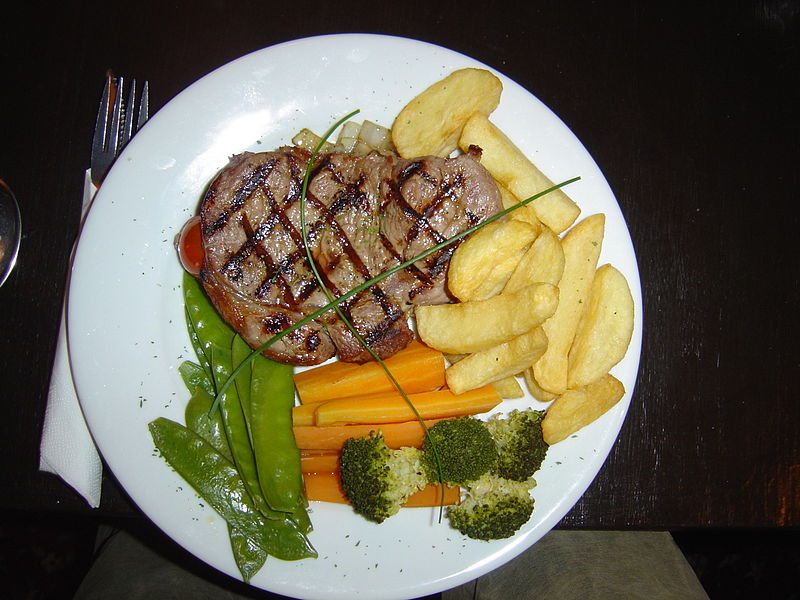
Concentrate on getting the number of servings for each food type that I’ve emphasized. The percentages will take care of themselves if you focus on a variety of wholesome carbohydrates, fruits and vegetables, low-fat dairy products, lean cuts of meat, and legumes. Here’s a tip: carbohydrates, such as whole grains, vegetables, and beans, should cover most of the space on your dinner plate. Protein should be the accompaniment, not the centerpiece that many people make it. This guideline is true both at home and when you eat out.
Following these guidelines requires a big change in eating habits for many people. Two good books on eating for athletes are the Sports Nutrition Guidebook by Nancy Clark, Human Kinetics, 1996, and Power Foods by Liz Applegate, Rodale Press, 1994. It can also help to consult a registered dietitian. Registered dietitians have the initials R.D. after their names. Contact the local branch of the American Dietetic Association to find one in your area.