Wednesday, September 30, 2009

Personal Betting


I’ve always been a competitor, ever since I was the fastest kid in a run during gym class in school. Seeing how fast I can run has long been my primary motivation to be a runner. Oddly enough, that’s why I stopped running for a few years after college. My goal then had been to break 9:00 for two miles, and I did. I didn’t see the point in racing anymore, so I didn’t see the point in running anymore. (Now, of course, I know better. What’s that about youth being wasted on the young?)
I was fortunate to be able to win races when I was younger. I’m not going to lie to you and tell you that doing so wasn’t incredibly satisfying. Let me tell you, if you ever need motivation to get out the door for a run on a tough New England winter day, try telling yourself that you’ll be defending your title at the Boston Marathon in a couple of months. It worked wonders for me.
But even when I raced for place, I was also always focused on my finishing times in races. Now that I don’t win races anymore, I’m even more fanatical about them. I’m certainly not alone in that regard. For many runners, setting personal records, or getting under a certain barrier for a distance, or seeing how their time at a race this year compares to what they ran there last year, or any of the million other ways that you can look at your running times provides the biggest reason to race. There’s something intoxicating about racing against yourself.
Your race times provide an objective record of your accomplishment on that day. There’s just no way around it—your race time is how long it took you to run this course on this day. Unlike other sports competitions, races are about unadulterated human performance. In other sports, you’re maneuvering against your opponents and trying to finesse some piece of equipment. When you race for time, it’s just you, the elements, and the clock.
Nothing else I’ve found in sports gives you that yes-or-no sense of accomplishment that racing for time does. Suppose you play on a softball team. How do you know whether you’ve had a good game? There are so many variables that you don’t have primary control over. Did you get two hits because you swung the bat well or because the other team’s pitcher stunk? What about when you made that nice play at third base, but the first baseman flubbed your throw, or the umpire made the wrong call? There’s none of that uncertainty when you race for time.
Earlier in this chapter, I told you how aiming for a race is one of the best ways to set the short-term goals I keep recommending. On top of that, aiming toward a race and having a time goal for it helps to keep you running even more. It lends a logic to your training—with the race as your goal, you have a better idea of what types of running you should be doing. Those time goals are a great answer for that little voice in your head that’s occasionally going to say, “Why are you doing this?”

Racing’s Best-Kept Secret: It’s Fun!


People who haven’t been to races aren’t going to know this, so you’ll just have to take my word for it until you see it for yourself: You’d be hard-pressed to find an event more filled with smiles and unambiguous goodwill than your local road race. Put another way, why should you race? Because it’s fun!
A road race is the closest thing to a mobile party that I can think of. (Well, the closest legal thing.) Everywhere you look, there are smiles, cheers, laughs, and heartfelt congratulations from one runner to another. There’s music before and after (sometimes even during), there’s great food after, prizes are given out, and kids are roaming all around—sounds more like a circus than someplace where a bunch of skinny masochists gather to be miserable together, doesn’t it?
Of course, most people aren’t laughing it up and smiling during the race; they’re working pretty darned hard. But that effort explains the festive atmosphere afterward. The runners have pushed and challenged themselves, and now they’re all celebrating the sense of accomplishment that doing so brings.
In life, isn’t one extreme of something usually more enjoyable if you’ve recently been near the other extreme? Isn’t a sunny day more special when it’s been raining for a week than when it’s the 10th bright day in a row? Doesn’t your easy chair feel best when you’ve been working your hardest? That’s why races are so much fun. Once you’ve experienced a race, you’ll agree with me that there’s a certain kind of fun that comes from challenging yourself within sharply defined parameters while others around you are doing the same.

People Pay to Do This?

The average road race is held early on a Sunday morning. A standard road race with T-shirts, awards, post-race refreshments, and so on costs $15 to $25 to enter. In other words, most people running in them have gone to bed early on a Saturday night, gotten up at least as early on a Sunday morning as on a regular workday, and then handed over the cost of a nice dinner for the opportunity to inflict pain on themselves. Sounds like they’re the idiots, huh?
They’re far from it, and I’m not just sensitive to that charge because I go to 25 to 30 races a year. At some level, these runners realize that far from being masochists, they’re indulging themselves. That’s right—indulging themselves! Racing is the proverbial icing on the running cake.
Your regular training gives you the big health and fitness benefits that are the most
important thing about running for most people, but experiencing only that part of
running can get a little tedious. You need some excitement and some variety in anything
that you do regularly, no matter how much you love it. In running, that excitement and
variety most often comes from going to a race. You don’t even have to try to run harder
than you do when you run on your own. There’s just something about lining up with
your fellow runners and experiencing the same course together that adds an element to
your running that’s impossible to find otherwise. Say you really like to cook. Which would you rather do: Always cook for just you and
your spouse, making pretty much the same types of dishes at the same time of day? Or would you rather use those daily cooking sessions as the main way to enjoy your hobby, but also throw a dinner party once in a while where you get to put it all on the line and let yourself and others see just what you’re capable of? Most people would choose the second option, and that’s why you see so many people at races. Let’s continue that dinner party analogy just a bit farther. Say you invite a few friends over for dinner. You don’t worry about how your culinary skills compare to Wolfgang Puck’s, do you? No. You do the best you can given your background and ability, and afterward you’re rewarded with the feeling of a job well done.
The same is true of nearly all of the people in any race. They know that they don’t have to look like Frank Shorter or Joan Benoit Samuelson to race. They know that races give their running a focus and are a great source of motivation for getting out the door most days.
Many beginning runners have a sense that their running would be more exciting if they went to races, but they’re afraid that they’ll finish last and be embarrassed. As Richard
Nixon would have said, let me say this about that: First, most races have at least a few hundred runners in them. Just like only one person is going to finish first, only one person is going to finish last. The odds of that being you are pretty long, believe me. More important, if it is you, so what? No one has ever been shot or even booed for finishing last in a road race. In fact, some of the loudest applause from spectators in races are for those near the back of the pack. The spectators recognize the extra effort that these runners are putting out. Adding to that applause are often many of the runners who have finished their races, and then hung around the finish area to cheer on their fellow runners. That kind of camaraderie with your fellow runners is one of the main draws that races have.

Monday, August 31, 2009

Made in the Shade: Sun Protection


People used to think that a great tan was one of running’s main side benefits. Now we know better. There are almost a million new cases of skin cancer every year in the United States. My grandfather died from a melanoma, and my mom has had skin cancer, so I’m especially aware of this problem. But it’s not just those of us with a family history of these problems who need to be careful, especially with the growing hole in the ozone layer. These days, smart runners can take a few, easy steps to lower their risk of overexposure to the sun.
The major one is to wear a waterproof sunscreen. It should have an SPF (sun protection factor) rating of at least 15. Ten to 15 minutes before your run, apply it liberally to any body parts that are going to be exposed. In the past, you may have heard that these sport sunscreens interfered with sweating, making you much hotter. Recent research, however, has shown that you’ll sweat just as much when you wear sunscreen, so glop it on.
Other steps to lower your sun exposure while running include the following:
  • Wear something on your head to shield your face.
  • Wear sport sunglasses to protect your eyes.
  • Try not to run when the sun is strongest, from 10 a.m. to 2 p.m.
  • Run in the shade. (You’ll also stay cooler if you do.) If you’re lucky enough to be running during daylight hours in the winter, don’t forget the sunscreen. The sun isn’t as strong then, but it can do its work nonetheless, especially when it’s reflecting off snow.

Neither Sleet, nor Hail: Foul-Weather Running


Along with the frozen-lung query, one of the other most common weather-related questions I hear is, “What do you do when it rains?” The answer: Get wet. What I mean, without being too much of a martyr about it, is that part of being a runner is coping with the hand that Mother Nature deals. Again, most people in our society have lost their connection to the outdoors. The only running in the rain they can imagine is from their office building to the car so that they don’t get wet.
But what do you do after a run? You get in the shower; you get wet. Why is so horrible to get wet during your run? Unless the rain is cold, running in the rain can be incredibly enjoyable. Think about when you were a kid and how you splashed in puddles or how good it felt to be in the rain in the middle of summer.
Of course, running in the rain isn’t always ideal. As I said, a cold rain is not that fun. You have to be extra careful, especially if you’re running near a lot of traffic. Cars aren’t going to be able to see you as well. But most times, putting on the right gear and a baseball or painter’s cap is the only added step you need to take to have a great run. When you get home, just be sure to change into dry clothes as soon as possible. Notice how I keep mentioning cold rain? I’m not going to tell you that being a runner means you stick to your planned run no matter what the conditions. Freezing rain, sleet, hail—when the weather is that bad, it’s usually time to reconsider. Shorten your run, sticking close to home so that you can end the run quickly if conditions deteriorate. Or, if the nasty stuff is only going to be around for a day, don’t feel guilty about taking the day off. You can get battered around if you always try to run in those conditions. I once had to take cover while running during a major hail storm in Arizona. The only other weather I really fear is lightning. I just don’t go out when it’s striking.
Fortunately, you can usually wait for it to pass and get in a nice post-storm run.

Friday, July 31, 2009

Footing, Short Days, and Icy Roads


The lack of light, not the potential freezing of your lungs, is the biggest threat to your well-being when you run in the winter. Watch your footing. Try to run on level surfaces that you’re familiar with and choose the most well-lit routes. Be extra careful after snow or ice storms. Snow on the ground can often help your night vision, because it reflects what light there is. But under that snow may be patches of ice. Also, watch traffic even more than you usually do. Don’t assume that cars can see you or that, if they do, they can get out of the way quickly. Just as snow and ice can make you slip around during your runs, they also can cause cars to careen out of control. Fortunately, most good winter running apparel made these days has reflective features. If yours doesn’t, you can buy reflective strips and a reflective vest at most running stores. Almost all good running shoes have reflective elements built into their design. These elements are a must if you want to run safely in the dark.

The Freeze-Your-Lungs Myth


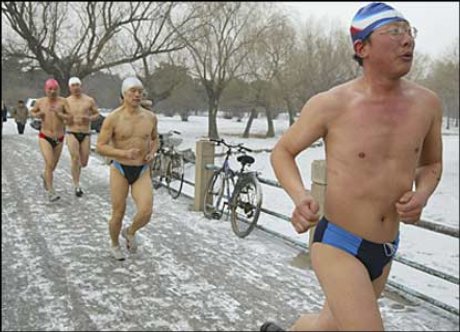
Except for the few hottest days of the year, most people aren’t going to question your sanity when you’re out running in July or August. But keep running through the winter, and eventually someone is going to ask you, “Aren’t you afraid that you’ll freeze your lungs?”
Even my dad used to ask me this when I started running in high school. I was taught to respect my elders, so I didn’t laugh in his face or anything, but this question is one of the silliest I’ve ever heard. Have you ever met someone who has frozen a lung? Of course not. As the air you breathe works its way into your lungs, it’s warmed more than enough to keep it from freezing anything.
I bet you have met someone who was in pretty good shape, but stopped working out when it got cold, and started the spring with more weight and less fitness. That’s a shame, and an unnecessary one, because winter running can be some of the best of the year. And I’m a New Englander, so it’s not like I’m sitting here espousing the joys of winter running from my house in Los Angeles.
I get a certain pride out of knowing that on those short, dark, cold days with plenty of windchill, when most people are always under shelter, I’ve been outside moving under my own power. I know that when people look out their windows and see me running down their street they think that I’m both miserable and insane. Those people don’t know that when I’m done with my run, I’ll enjoy being inside that much more. Running in the winter involves a bigger mental aspect to it than running during the rest of the year. I admit that after doing this for 30 years, I still sometimes have a tough time getting psyched to run when there’s only been eight hours of daylight for the last couple of months. You just need to keep focused on your goals. After awhile, you’ll learn how to get out the door and through those tough first few minutes until you start getting warmed up. I can usually do this by reminding myself how much better I’ll feel after my run. Also, ask yourself if you would be so ready to bag your run if it were sunny and 70 degrees.