Friday, July 31, 2009

The Freeze-Your-Lungs Myth


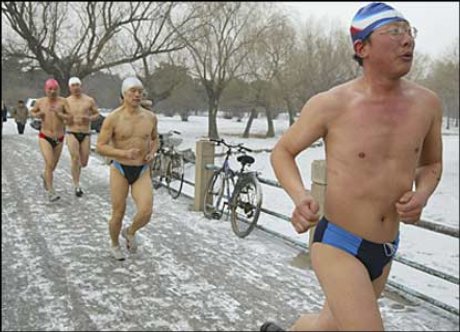
Except for the few hottest days of the year, most people aren’t going to question your sanity when you’re out running in July or August. But keep running through the winter, and eventually someone is going to ask you, “Aren’t you afraid that you’ll freeze your lungs?”
Even my dad used to ask me this when I started running in high school. I was taught to respect my elders, so I didn’t laugh in his face or anything, but this question is one of the silliest I’ve ever heard. Have you ever met someone who has frozen a lung? Of course not. As the air you breathe works its way into your lungs, it’s warmed more than enough to keep it from freezing anything.
I bet you have met someone who was in pretty good shape, but stopped working out when it got cold, and started the spring with more weight and less fitness. That’s a shame, and an unnecessary one, because winter running can be some of the best of the year. And I’m a New Englander, so it’s not like I’m sitting here espousing the joys of winter running from my house in Los Angeles.
I get a certain pride out of knowing that on those short, dark, cold days with plenty of windchill, when most people are always under shelter, I’ve been outside moving under my own power. I know that when people look out their windows and see me running down their street they think that I’m both miserable and insane. Those people don’t know that when I’m done with my run, I’ll enjoy being inside that much more. Running in the winter involves a bigger mental aspect to it than running during the rest of the year. I admit that after doing this for 30 years, I still sometimes have a tough time getting psyched to run when there’s only been eight hours of daylight for the last couple of months. You just need to keep focused on your goals. After awhile, you’ll learn how to get out the door and through those tough first few minutes until you start getting warmed up. I can usually do this by reminding myself how much better I’ll feel after my run. Also, ask yourself if you would be so ready to bag your run if it were sunny and 70 degrees.

Jogging in Winter


One of the main reasons that running in the winter can be so nice is because running in the summer can be so tough. With all the heat that you generate after a few minutes of running, you can be warmer running outside in 40-degree weather than inside your 68-degree home. So you stay warm enough to stay comfortable, but don’t get so hot that you get really dehydrated. The best of both worlds!
You can’t get away with running in just anything in the winter. Some necessary items of clothing will help you stay comfortable when it’s cold. The key is wearing the right gear for the right conditions, which usually involves layering.

Tuesday, June 30, 2009

Beating the Heat


Now that I’ve completely turned you off on running in the heat, what can you do to fight dehydration? Drink, drink, then drink some more. Your thirst mechanism is imperfect; by the time you’re thirsty, you’re dehydrated. How do you know if you’re staying on top of staying hydrated? First, weigh yourself before and after runs in hot weather. However much lighter you are at the end of the run, drink at least that amount of water within the first two hours of your run. Remember, a pint’s a pound the world around, so for every pound you lost on the run, drink 16 ounces.
Don’t cheat on this method if one of the reasons you’re running is to lose weight. The weight that you lose on a run in the heat isn’t fat. It’s water and needs to be replaced if you want to keep running. Your blood and other body fluids help to remove waste products and to carry nutrients to muscle tissues, so the faster you replace lost fluids, the more quickly you’ll recover from run to run. Replacing water doesn’t have anything to do with how many calories you burn on a run, which is what counts in determining how much fat you lose. If anything, quickly replacing water weight loss will help you lose weight because you’ll feel better from day to day, and you’ll be more likely to stick with your running in tough conditions.
For some reason, it’s tough for most people to stay hydrated. Maybe that’s because eating is one of life’s great joys, but after awhile, drinking water just gets boring. Make it easy to drink water often throughout the day. One coach I know tells his runners to keep a two liter bottle of water at their desks at work. They’re supposed to finish it at least once from when they get to the office until they go home. I also know runners who are in the habit of stopping for a drink at every water fountain they pass during the day, regardless of whether they’re thirsty. It’s also a good idea to keep a bottle of water by your bed. I know this sounds like a lot of work, maybe even borderline obsessive. But it’s worth it, because you’ll feel so much better on your runs.
Not only is it important to drink water before, after, and between runs, it’s important to drink during them as well. I keep a water bottle hidden in the woods a few miles from my house. When I run by it, I stop and drink, and then restash it. When it’s empty, I carry it home, refill it, and drive it back to its hiding spot. Here are other ways to conveniently get drinks on the run:
➤ Plan your route so that you’ll pass schools, gas stations, and other places that have water fountains.
➤ Plan your route so that you pass your home once or twice. Have a water bottle waiting for you at the end of driveway.
➤ The night or morning before a longer run, drive over your route, stashing bottles along the way.
➤ On the hottest days, carry water with you. Many runners prefer fannypacks that hold bottles to keep their hands free and their arm action normal. If you can use some of these methods to make sure you get some fluid every 15 to 20 minutes during your run, you’ll last a lot longer in the heat.
I also like to drink two or three glasses of water a few minutes before I run. Sometimes the water sloshes around in my stomach at the start, but I know it will help me by the end of the run. Nothing beats water for pure hydration. But you’re more likely to drink enough if you enjoy a variety of fluids. What are other good options for just before, during, and right after a run? Studies have shown that sport drinks that are four to eight percent carbohydrate, like most of the commercially available ones, are absorbed as quickly as water. They have the added plus of providing energy. Fruit juices aren’t absorbed as quickly; dilute them by half with water. Carbonated beverages aren’t a great idea because they might upset your stomach and because they make you feel full. If you drink a carbonated drink, you might think that you’re more hydrated
than you are.
Finally, when you run can make a big difference i\how much the heat takes out of you especially when you’re not acclimatized (used to running in the heat).
Avoid the hottest times of the day. This is one instance where you’re at an advantage if you have to squeeze in your run before or after work. Still, be careful: The humidity is highest in the morning, and it can still be pretty oppressive at 7 p.m. in some places in the summer. When in doubt, slow your pace from the start, rather than having your dehydrated body slow it for you near the end.

Sunday, May 31, 2009

The Dangers of Dehydration


The upshot of all this dripping sweat is a dropping pace. One study found that for each one percent of body weight that you lose because of dehydration, your running performance falls by three percent. Bear in mind that one percent of body weight isn’t much— if you weigh 150 pounds, that’s only 1.5 pounds, or 24 ounces. It’s not unusual to lose three or four pounds of water in an hour of running on a hot day. This loss causes your performance to sag by more than five percent, which can be as much as a minute slower
per mile. Are you starting to see why it’s so tough to
feel comfortable while running in the heat?
You also need to consider cumulative dehydration.
Cumulative dehydration is what happens when it’s hot for several days in a row, and you don’t replace all the fluid you lost after each run. Suppose that during a hot week, an 150-pound runner doesn’t rehydrate himself completely each day. By the end of the week, he has a cumulative loss of two pounds of water—that’s more than one percent of his weight. As a result, his performance is off by more than three percent by week’s end, but he may not make the connection to dehydration.
A lot of runners, myself included most summers,
go through the hottest parts of the year chronically
dehydrated. As a result, our running suffers.

A Hot Time in the City


You know that you tire more quickly when it’s 90 degrees rather than 50 degrees, even if you’re just taking a leisurely stroll. And you know that the harder you work, the more tired heat makes you. But why is that? And what can you do about it? When you run in the heat, your body sends more blood to your skin to cool you via evaporation. As a result, less blood, which carries oxygen, goes to your leg muscles, and they have to work harder just to maintain your usual pace. Also, the warmer it is, the more you sweat. This is good, because sweating helps to cool you as your perspiration evaporates. But it’s also bad, because your blood volume decreases. With less blood returning to your heart, your heart has to pump more often to keep the same amount of blood circulating throughout your body. And when your heart rate increases, you’re working harder.\ Running is even tougher on humid days. You generate all that sweat, and it’s supposed to cool you down, but the air is so moist that it can’t absorb much more water. So your sweat stays on your skin rather than evaporating, and your body just keeps producing more and more sweat, and you just keep getting more and more tired. That’s why it’s a lot tougher to run on a 90-degree day in the humid Northeast part of the country, like Washington, DC, than in someplace like New Mexico. Out in the desert, it’s hot, but dry, and your sweat can cool you like it’s supposed to.

Thursday, April 30, 2009

Post-Partum Expression and Running


The answer to how much and how fast to run after giving birth, just like how much and how fast to run before giving birth, differs from woman to woman. A lot of it has to do with how tough your pregnancy and delivery were. A standard guideline is to wait about six weeks after a vaginal delivery, a bit more for a C-section. Again, though, those are just general guidelines. Part of being a runner is being in touch with your body, and you should have a feel for when it’s right to get going again. Gwyn Coogan started running again only 10 days after giving birth, but Janis Klecker waited eight weeks. As some women runners have pointed out, you never know until it’s too late if you tried to come back too soon. In this sense, starting to run again after giving birth can be a lot like starting again after an injury. You’re always going to be wondering if it’s OK to try to progress, and you’re going to feel a lot different running than you used to. That’s especially the case for new mothers who are probably trying to run with more weight than they had before being pregnant.
Your joints and ligaments remain loose for about nine months to a year after delivery. This looseness makes you especially susceptible to injury during this time, so you should avoid hills and uneven terrain. Put all those factors together, and most women runners who have been through the process, even highly motivated ones like Coogan and Klecker, think it’s a good idea to err on the side of caution. Some women say that once they return to their regular running program after giving birth, they feel much stronger. Of course, there’s a psychological side to this. As Louise Kelley, a top local runner in the Washington, DC area, says about being a running mother, there’s nothing like a forced nine months off to get you really motivated.

Play, Don’t Labor: Running While Pregnant


Pregnant women used to be told any exercise beyond even the most low-key, minimal exertion would endanger both their health and that of their fetus. The main concern was that the mother and fetus wouldn’t gain enough weight to produce a healthy baby come birth. It was also thought that when a pregnant woman runs, the fetus would be harmed because of less oxygen and blood flow going to the uterus. Because of fears like these, the American College of Obstetrics and Gynecology (ACOG) used to say that pregnant women shouldn’t work out strenuously for more than 15 minutes and that they should keep their heart rates below 140 beats per minute. In other words, don’t really run. A lot of faithful women runners chose to ignore those recommendations when they became pregnant. As they did, and seemed to produce normal, healthy babies, more studies were done about running and pregnancy. Among other good things, these studies found that the fears of damage to the fetus by running moms-to-be were unfounded. The pregnant body has compensatory mechanisms for decreased oxygen and blood flow to the uterus. It’s been shown that both the woman and fetus have all the fuel they need when the woman runs, even in the late stages of pregnancy, when fetal growth really takes off. Hey, Sue Olsen had to get energy somewhere during that 24-hour race, after all.
In terms of birth and after, studies have shown no real difference between sedentary pregnant women and active ones in these important matters:
➤ Complications of pregnancy, labor, and delivery
➤ Type of delivery (C-section versus vaginal)
➤ Circumference of the baby’s head
➤ Overall health of the baby
➤ Weight of the baby at birth
As for weight gain during pregnancy, one study found that active pregnant women put on about 30 pounds each, compared to 39 to 42 pounds for nonexercisers. ACOG recommends that most women gain 25 to 35 pounds.
One study compared women who worked out vigorously, including running, to those whose only exercise while pregnant was walking. When the children of these women were five years old, those of the intense exercisers scored higher on tests of intelligence, coordination, and language skills.
Because of all of this evidence that vigorous exercise is safe, ACOG revised its guidelines in 1994. Now, it encourages women who are fit and active when they become pregnant to remain so as long as they can comfortably during pregnancy. So long as you keep in close contact with your doctor and use common sense, ACOG says, it’s OK to run vigorously throughout your entire pregnancy.
Now, whether Sue Olsen’s exploits would get the ACOG seal of approval, I’m not sure. But I bet they wouldn’t have any problem with Joan Benoit Samuelson, who ran five miles on the morning before she gave birth to her second child, and remembers the
run as one of the favorites of her whole life. Remember, this is a woman who won the Olympic Marathon!
Sue and Joan are among the luckiest ones. No matter how many green lights ACOG gives you, and no matter how dedicated you are, there comes a time when intensive weight-bearing exercise like running becomes too uncomfortable to be worth doing for most pregnant women. If and when that occurs will vary from woman to woman and even from pregnancy to pregnancy for repeat moms. That’s where the common sense part of ACOG’s current guidelines come into play.
When running isn’t an option anymore, many women runners turn to less-intensive cross-training options.
When Janis Klecker, a 1992 Olympian in the marathon, was six months into her second pregnancy and pregnant with twins, running became a hindrance rather than a help. So she switched to swimming, walking, and riding a stationary bike. An Olympic teammate of hers from 1992, Gwyn Coogan, ran until the seventh month of her pregnancy, and then switched to hiking, biking, and swimming. The key is that they sensed when the running wasn’t worth doing anymore, accepted that temporary situation, and found other, more comfortable, ways to stay fit and active.