Tuesday, May 31, 2011

Retired Runners


People today switch not just jobs, but careers several times in their work years. That wasn’t usually the case for the generation of people now retiring. These were the company men—you got a job with Industrial Behemoth, Inc. when you were young, and you stayed there until you retired. You weren’t encouraged to do much more than be an employee, a husband, and a father. The women were encouraged to stay home and raise the kids while tending to the endless household chores. You didn’t have hobbies; you had responsibilities.
But what now? You’ve retired, the kids are long gone and that dream of hours of leisure time might have become a nightmare. Throughout this book, I’ve shown how running is not just exercise; it’s a lifestyle. No, you’re not going to spend your entire day running, but it does help to center your day. Having this activity on your schedule has a way of organizing your day; there seems to be more of a purpose to what you do. I keep mentioning how running improves the quality of your life. This benefit is especially important for older people, who suffer from depression at a higher rate than young people. One of the most amazing runners I know of is Warren Utes of Park Forest, Illinois. Utes began running in 1978 at age 58. When he retired in 1985, he had several years of base behind him and went on a running rampage that hasn’t stopped. Among his many records are a 39:41 10K at age 74, making him the oldest person ever to break 40:00 for the distance. Need me to do the math? That’s almost 6:20 per mile for 6.2 miles! Utes runs 60 miles a week and is having the time of his life. Wouldn’t you like to join him?

Leaving Youth in the Dust

If you’re over the age of 50 and have been sedentary for a long time, do you remember how you felt more than 20 years ago? Probably pretty darned good, huh? Even if you weren’t brimming with vitality, you probably wouldn’t mind feeling like that again instead of how you feel now, right? Well, if you start running, you can feel that way again.
A study of runners age 50 and older compared them to healthy nonrunners in their 20s. The women runners had an average level of aerobic fitness the same as the sedentary 20-somethings, and the 50+ men runners had slightly higher aerobic capacities than the young couch potatoes. Based on these figures, you could say that running cuts 20 to 30 years from your age!

All Ages Welcome


It’s never too late to get in shape. People who start running in their 70s will see the same kinds of gains that people in their 20s do. The principles that underlie why your aerobic capacity and strength increase when you start running have no idea how old you are. That’s not what older people have traditionally been told. People past the age of 60 were told to take it easy—maybe putter around the garden a couple of times a week or walk the dog (assuming the dog is no bigger than a dachshund). Get the old ticker going, and you’ll be pushing up daisies, not pulling in Social Security. Getting sick and increasingly dependent on others is an inevitable part of getting old, we were told. Now we know that that advice, like history, is bunk. As one of the leading researchers in this area likes to say, what most people think of as the natural consequences of aging are really the “atrophy of disuse.” Our bodies are machines that like being used. Start them up at a good rate after years of practicing “atrophy of disuse,” and they will thank you for it.
One study started a group of sedentary men in their 60s on a walking and running program. They worked out four times a week for 30 minutes at 70 percent of their maximum heart rate. (Sound familiar? See Chapter 3.) After only four weeks, their aerobic capacity had increased by six percent, and their heart rate at their training pace decreased by 10 beats per minute. After another five weeks, they had another six percent increase in aerobic capacity, and their training heart rate fell another six beats.
Older people can benefit from strength training as well. One of the main reasons that older people lose independence, and with it, quality of life, is because they’ve lost so much muscle mass that they can’t perform basic daily tasks. Being unable to lift more than five pounds might not seem like much of a big deal until you do some quick math: Half a gallon of milk weighs three pounds. Go to the store and buy that, a few pieces of fruit, and maybe some chicken breast, and you better be able to lift more than five pounds unless you want to rely on others to carry even the lightest groceries for you.
A famous study at Tufts University started frail people in their 80s on a serious weight training program. The old folks did repetitions at 80 percent of their one-rep maximum. That’s hard work for anyone, believe me. In just eight weeks, their strength more than doubled.
The bottom line: Not only can older sedentary people start an exercise program like younger people, but they should. The benefits of exercise, as well as the principles for obtaining these benefits, are the same no matter what your age.

Thursday, March 31, 2011

Teen Angels: High School Runners


Once kids are in high school, it’s OK for them to become more serious about competition. By this age, they’ll be able to understand what training is and how sometimes you have to suffer in the present to have a better future. Racing might still be frustrating (it is for everyone at some point), but if they’ve freely chosen to compete, then a few bad experiences probably won’t sour them on running for the rest of their lives. Also, by this age, their bodies can handle the training better. Training for even the longest distances usually offered in high school (5K for cross-country, two miles for track) involves a lot of short, fast speed work, usually on the track. By high school age, more runners are going to be able to do this type of training without breaking down. Most children who race the mile or two-mile in outdoor track are going to top out at about 30 miles a week. Anything more than that, and I’d get a little wary. Certainly, some teens can handle more running than that, especially if they started when they were younger. But even in high school, I think it’s worth erring on the side of caution.
Some coaches are going to encourage members of the team to run more. It’s not unheard of for cross-country team members to run 70 or so miles a week. Whether that’s a good idea is going to be a judgment call. If a high school runner is doing that kind of mileage and understands why, then it can be OK, so long as the runners on the team are progressing and enjoying themselves. But if most members of the team aren’t progressing, then the coach is trying to use methods that might work with older, more developed runners on younger ones who aren’t ready yet for that high of a level of training. Because most high school runners are new to the sport, they should see steady progress in bringing their times down. If they’ve plateaued, it usually means that they’re doing too much.

The Right Races for Rug Rats


In the 1970s, a young runner named Wesley Paul ran faster than 3:00 for the marathon at age 9, the youngest that anyone had ever done so. This feat got him a lot of attention in the press, and one running magazine even speculated that he would grow up to break the world record. You don’t hear about Wesley Paul these days, however. That’s not surprising. For whatever reason, almost every child who is highly motivated to compete in races at a young age doesn’t become a lifetime runner. Probably for the same reason that kids who are gymnastics dynamos aren’t big on tumbling when they’re 40 years old—the activity is associated with a lot of pressure, not fun, and we all have enough pressure in our adult lives as it is.
I’m not a big fan of age-group track meets for junior high and elementary school kids. There’s just too much of a risk that the children are so serious at such a young age for the wrong reasons. Sure, some of the runners might be mature enough to be able to state why they’re training hard toward meeting competitive goals, but I’d rather err on the side of caution. Kids who have the ability and interest to become top runners will have plenty of time to work on that goal later, when both their minds and bodies are more mature, and they can make fuller use of their potential.
Kids are naturally competitive. Watch the start of these children’s runs, and you’ll see the term “youthful exuberance” defined. They just tear away from the starting line in a sprint! But to keep the events fun and worthwhile for all the young runners, children’s races should give some kind of award to every finisher. At a young age, the top finishers are going to place first because they have more talent for running. Preparing for the event doesn’t factor into winning as it does for adults, especially at short distances. Acknowledging all of the participants, by giving them all identical finisher’s medals, for example, gets across the idea that the most important victory is participating. This emphasis encourages the slower kids to keep coming back and to view running as a sport that’s for everyone, not just the talented few. Kids see enough of the elitist view of sports as it is, with the overemphasis that school sports such as football and basketball receive.

Monday, February 28, 2011

The Fun of Family Fitness


My wife and I like to introduce our two daughters to as many activities as possible. Sure, running is one of them, and it’s kind of hard for them not to notice that it seems as though Daddy is always heading out the door for a run. But we never tell them how running is the greatest sport, or how they’re wasting their time when they’re skating, dancing, boating, playing basketball or tennis, or doing any of the other activities that they’ve found that they enjoy.
What we want to do is get across the idea that fitness is a lifestyle. We want to show them that being active and healthy and feeling good while using your body on a regular basis should be the norm. Children are much more likely to develop good fitness habits for the rest of their lives if they see that fitness is important to you. That’s a much better message to send than presenting fitness as an occasional intrusion that you have to tend to out of obligation. In terms of running, this approach means that if your child expresses an interest in it, explore that interest together. Go for a run with your kid. Take him or her to your races, not so much to run, but to show the festive atmosphere that races have. Do what you can to expose your child to those elements of running that are going to have the most appeal to kids.
You might not think so, but one of the biggest appeals of running is going to be the chance to spend some quality time with you. Young kids, especially, will do almost anything to get adult attention. So if they want to run with you, indulge them. Running together can strengthen your relationship, because the child will see your runs as one-on one, undivided attention time. Let these runs unfold on the child’s terms. That might mean jumping through puddles, or stopping to look at animals, or heading home after just a few minutes. Let them set the pace and the course. Remember, it’s supposed to be fun for them, which means feeling good right then.

Keep It Enjoyable!


Even if your kids want to run for all the right reasons, I don’t think that children under the age of 14 should look at their running as training. This advice doesn’t mean that children under this age can’t run as much as 20 miles a week. If they want to run that much, enjoy doing so, and don’t get hurt, I think that’s an acceptable upper limit of mileage for preteens. Three miles or 30 minutes are good measures of the farthest that young runners should go at a time.
But although kids may run as much as adults, running should remain a part of their play and one of many regular activities, not something that they plan and obsess about. Going for a run should be primarily about enjoying it on that day, not to build endurance so that they can try to run twice as far in a month. This book has emphasized that if you’re going to make progress in your running, then you need to be consistent with it. Kids who run should ignore all of that. If they hit a spell where they don’t feel like running for a month or two, don’t force them to. If you do, you’re sending the message that running is something that they have to do, not that they want to do.

Be a Running Role Model


You certainly shouldn’t force children into running. Little League syndrome is as bad in running as it is in baseball. Children can sense when you’re pushing them into an activity. They might not resist immediately, but eventually they will. Having fun consistently ranks as the top reason that kids give for participating in sports. For preteens, fun almost always means the here and now. Most preteens haven’t developed what psychologists call abstract thinking, the ability to set long-term goals and to see how doing something that might not feel good right now is worth it for the pay-off later. In a certain sense, isn’t that what a lot of running is about? A big motivation for getting out for a run today is because you know that doing so will benefit you later—you’ll feel better the next day, or you’ll be able to run faster in a race a month from now, or you’re working toward a weight-loss goal, or you’re making one of an ongoing series of contributions to fighting disease, and so on. When children don’t come to running on their own terms, they’re not going to like it because they don’t yet have that sense of delayed gratification.
If a kid wants to run and can state why and seems to enjoy it, then I’m all for some low-level regular running.
Children’s attitudes toward running largely stem from what they notice about how the adults around them approach it. If you’re always walking around the house before your runs moaning about what a horrible chore running is, then don’t be surprised if your kids don’t show much interest in it. But if your children see that running to you means getting outside and exploring and feeling good and being with your friends and having fun, they’ll probably think otherwise. Running will seem like a form of play.

Friday, December 31, 2010

Should Children Run?


Of course children should run! Running should be as much a part of children’s lives as walking, skipping, playing tag, and so on. It should be a normal part of their play. For preteens, play can and should be the major source of physical activity. Some researchers have estimated that when kids are left to their own devices, they’ll cover as much as six miles a day on foot. Obviously, they don’t cover this distance all at once, and it’s a lot different from when an adult goes out for a six-mile run or walk, but that’s OK. At that age, most experts would agree, what you want is for your children to be active in a variety of activities that they enjoy.
Of course, many kids aren’t active. The average American teenager watches 22 hours of TV a week. Keep that in mind as you ponder these scary statistics: Only one-third of children ages 6 to 17 meet minimum standards of cardiovascular fitness. Of children between the ages of 5 and 8, 40 percent are obese, meaning that they weigh at least 20 percent more than they should. According to one survey of children in grades 4 to 12, 49 percent of boys and 62 percent of girls get nine hours or less of physical activity each week. When you consider that these estimates likely include a lot of time standing around on a ball field during gym classes, the figures seem even worse.
Now the question of whether children should run changes. Should children run in an organized way, for fitness, the way that adults do? That one’s a bit trickier to answer.

The Chase Corporate Challenge Series


Like the Race for the Cure Series, the Chase Corporate Challenge Series does a great job of luring new runners into the sport. It exposes occasional fitness runners to the racing scene and thereby shows them how fun it can be.
The Chase Corporate Challenge Series consists of runs in 16 cities in the United States, plus two overseas. The series culminates in a national final held on Park Avenue in New York City in October. In all, more than 175,000 runners take part in the series each year. Each race features team awards as well as individual recognition, such as first executive finisher. Each race is 3.5 miles long—a good challenging distance for the serious racers, but also a conquerable distance for the more casual runner.
In addition to introducing casual runners to the fun of racing, the Chase Corporate Challenge Series benefits runners in other ways. As you probably know, balancing your running with your work life can be tough. Work-based programs such as the Chase Series encourage employers to see their employees as more than just employees. They help show what employees do in the rest of their lives, and how important those pursuits are to them, and how having a healthy, rewarding life outside of work adds to, rather than detracts from, performance on the job.

The Race for the Cure Series


For you rock fans out there, sorry, but this series has nothing to do with that gloomy British band, The Cure. What it has to do with is a heck of a lot more important—finding a cure for breast cancer.
The Race for the Cure is the largest series of 5K runs in the United States. In 1997, the series was held in 77 cities throughout the country and included nearly half a million participants. The Susan G. Komen Breast Cancer Foundation organizes this series of runs; proceeds from the runs provide funding for local and national breast cancer research, education, screening, and treatment programs.
In case you haven’t noticed by now, I like it when there’s a connection between running and the rest of society. Apparently, a lot of others do, too, because The Race for the Cure Series gets bigger and bigger every year. Just one event in the series, the Washington, DC one, is the single largest 5K in the country. Vice President Gore and his wife, Tipper, regularly run it, in part because of their family’s history of breast cancer. That link exists for me, too, because my mom has had breast cancer. Many participants in these events are running in honor or memory of a breast cancer patient. Some in the field are even breast cancer survivors.

Tuesday, November 30, 2010

My Jingle Bell Runs


The Jingle Bell Runs are not just mine anymore, even though the official name is Bill Rodgers Jingle Bell Run. They’re not races in the traditional sense, which is why they’re on my list.
Just the Facts
My brother, Charlie, and I hold a few of these in the Boston area every year on different dates in December. These races are low-key fun runs of a few miles that raise money for charities. The largest one, in downtown Boston, attracts more than 3,000 runners. For more information, call my store, Bill Rodgers Running Center, at (617) 723-5612.
Jinglin’ All the Way for Charity
I started holding these runs from my running store more than 20 years ago. At first, they weren’t fundraisers for charity, just low-key runs with a few friends around the Boston Common and other parts of the city. We’d even stop at the tree outside of the Prudential Center and sing Christmas carols. It was a nice way to end the year after being so serious about training and racing so much of the time.
Now, the runs are a lot more organized, but they’ve kept that low-key feel to them. And we’ve made them fundraisers for different disabled children’s groups. I’m a former special ed teacher, so this aspect means the world to me. I like it when runners can make the connection between doing this great thing for themselves, running, and helping others. Now, most big cities have similar affairs, and I think it’s great that more runners have the chance to participate in these noncompetitive events and simultaneously do something for others.

Any Thanksgiving Race

Racing on Thanksgiving Day? Aren’t you supposed to spend the day watching TV and overeating? What’s next, racing on New Year’s Eve? Well, I’ve done that, too, which may have been taking things a bit far, but there’s nothing strange about going to a race on the most American of holidays. After all, what better way to work up an appetite for dinner?
Just the Facts
I’m guessing that you can figure out when these are held. Where are they? Believe it or not, in most towns that have a strong running community. Races on Thanksgiving Day morning have become as much of a celebratory running tradition as Fourth of July races. Check the sources I told you about in Chapter 18 to find a Thanksgiving Day race in your area.
Why Give Thanks on the Run?
The first road race of my life was the Manchester Road Race, a 4.75-miler held every
Thanksgiving Day morning on the streets of Manchester, Connecticut. Even when I first
did it, in 1966, it was a tradition-laden New England
event. I won the high school division in a time of
25:18. At the time, it was the longest race of my life. I don’t remember much about the race except that it seemed like an awfully long way. But I liked the feeling of being competent over this distance, which was more than what I was used to racing in high school races.
More than 20 years later, I was able to set a master’s course record in that race. I haven’t run the Manchester race in a while, but I always try to run in some event on Thanksgiving Day. You should, too. Why? To me, running a race is the ideal way to give thanks for having a healthy body that’s under your control.
Thanksgiving Day races, like most holiday events, are celebratory affairs. You’re out there with your family and friends, you have a lot of fun with bunches of other runners, and then you head home for a great dinner. Most Thanksgiving Day races give portions of their entry fees to food banks, or they encourage runners to bring cans of food to help the less fortunate.

The Walt Disney World Marathon


Maybe you’re starting to think that all of my favorite races are older ones that I’ve won. Not so. The Walt Disney World Marathon has been around only since the beginning of this decade, and I’ve never even competed seriously in it, much less won it, but it’s still worth recommending.
Just the Facts
The Walt Disney World Marathon is held in early January in, appropriately enough, Walt Disney World or more specifically, Lake Buena Vista, Florida. More than 5,000 marathoners finish it each year. In addition to the marathon, the event also has a children’s run the day before, a corporate relay, and a half marathon. To register, write Walt Disney World Marathon, P.O. Box 10,000, Lake Buena Vista, FL 32830; or call (407) 939-7810.
Disney Magic
The Walt Disney World Marathon is on my list because it’s emblematic of an important trend in races, namely, making them family-friendly. We running geeks used to go pound the pavement while our families were left to kill the time until we crossed the finish line. But race organizers have discovered that it’s better to involve as many members of the family as possible, rather than catering only to the hard-core marathoners. This family-friendly trend has grown as the average runner has become older and, therefore, more likely to have kids. Many races do a good job of making their weekend full of events for fit people of all ages and levels of seriousness. As the father of two young daughters, I like this emphasis and have enjoyed participating in Disney’s family 5K the day before the marathon. Of course, families have plenty of other things they can do during race weekend deep in the heart of Walt Disney World!
For kids of all ages, Walt Disney’s course has a certain charm. I grew up watching The Wonderful World of Disney on Sunday nights, so I’m a sucker for this stuff. Apparently, a lot of other “mature” runners are, too, if the number of people who rave every year about running through Cinderella’s Castle is any proof.

Sunday, October 31, 2010

The Bix 7-Miler


Another race that I look forward to every year is the Bix 7-Miler. Like Falmouth, it’s a summer race at a nonstandard distance, but that’s the least interesting thing about it.
The Bix 7-Miler, or just Bix, as everyone calls it, is held in late July in Davenport, Iowa. The race was started as part of an annual festival held in honor of Bix Beiderbecke, a seminal jazz trumpeter of the 1920s. Now, with 18,000 entrants, the race has become bigger than any other part of the festival. For more information, write 2685 Kimberly Road, Davenport, IA 52722; or call (319) 324-8657.
Bix’s seven-mile course is a tough one, including a huge hill right off the bat in the first mile. The weather is usually tough, too, what with the race held in the middle of summer in the middle of America’s farmland. Conditions at race time in 1997, for example, were 83 degrees with 80 percent humidity. These aren’t optimal running conditions! So what’s the big deal about Bix? Why not go somewhere you can run fast? Certainly, running on flat courses where you have a better chance of running a personal best can be fun, but always doing that is boring. If speed is your only goal, why not just go around a track? I think there’s more to racing than just seeing how fast you can go. Races that have character, like Bix, are challenging; running them is a good way to test your character as a runner.
Few things are going to get you through a tough course on a tough day any better than the incredibly supportive crowds that the race has. In addition to the great hometown pride of the Quad Cities’ residents, you’re guaranteed several more thousand spectators thanks to the concurrent jazz festival. I don’t mean to sound like I do nothing but party, but this race, too, has a great celebratory atmosphere, including steamboat casinos drifting by on the nearby Mississippi River.

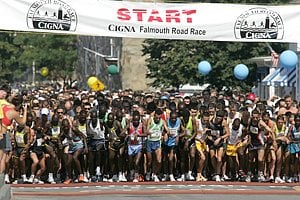
The Falmouth Road Race


What’s that you say? You’ve always wanted to run a race that starts on an incredibly narrow drawbridge and finishes right next to the Atlantic Ocean? Then look no further than the Falmouth Road Race.
The Falmouth Road Race is held in the middle of August. It starts in Woods Hole, Massachusetts (site of a famous oceanographic institute and the ferry to Martha’s Vineyard) and ends 7.1 miles later in seaside Falmouth. More than 8,000 runners take part every year. For an application, write P.O. Box 732, Falmouth, MA 02541; or call (508) 540-7000.
Falmouth is great for several reasons. It embodies the celebratory nature of racing that I’m so fond of; you finish right next to a huge field, where a post-race party/barbecue is held. Although some of the best runners in the world are in the field, the race has a vacationlike feel. I know one runner who makes it his only race of the year; he’s just so drawn to the atmosphere of New England by the ocean in late summer. I also like the point-topoint course that builds momentum as you near the finish, like at Boston. Speaking of the course, Falmouth’s course is one of the most beautiful in all of road racing. At about two miles, you run past a lighthouse that looks like something out of a Norman Rockwell painting. For most of the race, you’re either running along the ocean or on roads through shaded forests. Right at the end, you come over the top of a hill to descend the last few hundred yards to the finish line, where there’s always a huge crowd.

The New York City Marathon


If you’ve heard of a marathon besides Boston, it’s probably New York. After all, it’s kind of hard to ignore 30,000 people running through all five boroughs of the world’s most famous city.

After initially being held in October, the New York City Marathon is now held on the first Sunday in November in an attempt to escape the Indian summer days that often plagued runners during the earlier dates. The race’s popularity has continued to soar as it approaches its 30th running in 1999. In 1997, more than 30,000 runners started the race, which was a record field for New York.
The New York City Marathon is the gem of the weekly races put on by the New York Road Runners Club. Because so many people want to run in the New York Marathon, the field is limited by a lottery, with many of the spots saved for overseas runners. To request an application, write Marathon Entries, P.O. Box 1388 GPO, New York, NY 10116; call (212) 423-2249; or visit the Web site, http://www.nyrrc.org.

Thursday, September 30, 2010

The Boston Marathon


If you’ve heard of one runner’s race, this is probably it. I’ll make you a bet: Within your first year of running, if enough people see you running, eventually one of them is going to ask you, “Whaddya trainin’ for the Boston Marathon?” Another prediction: If you start going to races and let others know about it, eventually one of them will ask, “So, have you run the Boston Marathon?” There’s no more famous race in the world.
Just the Facts
The Boston Marathon starts at noon on Patriot’s Day every year. Patriot’s Day is a New England holiday that commemorates the Battle of Lexington on April 19, 1775; in Massachusetts, it’s a state holiday, and it falls on the third Monday in April. The race begins in Hopkinton, Massachusetts and ends in downtown Boston. The Boston Marathon is put on by the Boston Athletic Association. For an application, write BAA Boston Marathon, The Starting Line, One Ash Street, Hopkinton, MA 01748-1897; or visit the Web site, http://www.boston-marathon.org.
What’s So Special About Boston?
The Boston Marathon has it all: more than a century of history, a great course, and spectacular spectators. For average runners, it’s unique among marathons in that it has qualifying standards. The standards were introduced in 1971 to make the size of the field more manageable. The qualifying time has to be run on an accurately measured course within just more than a year before the Boston Marathon that you want to participate in.
The current standards are shown in the following list:
These standards are tough! For example, if you’re a woman under the age of 35, you have to run 26.2 miles at an average pace of 8:25 per mile or faster. Older folks certainly don’t get a break: a 70-year-old man has to average about 8:45 a mile for 26.2 miles just to make it to Boston’s starting line.
But rather than resent these standards, most runners I know appreciate them. After a few years of running, a lot of runners look at qualifying for Boston as their personal Olympics. Even if they make it just once in their lives, or even if they fall short, they value the challenge that the Boston qualifying standards offer. If only for this once in their running life, they like the idea of having this inflexible goal that they’re willing to make great sacrifices to meet.
The most special thing about Boston is its course and the crowds that line it. You start in a small, New England village and then make your way through several towns with names that have meaning to all marathoners: Ashland, Framingham, Natick, and so on. Near halfway, you pass an all-women’s college, Wellesley, where the roar from the students was so loud that when three-time champion Ibrahim Hussein passed through in 1992, he covered his ears. Then it’s the famous Newton Hills, finishing with Heartbreak Hill, which crests at 21 miles. From its top, you have five mostly downhill miles to the finish right near Copley Square in downtown Boston.

How to Finish a Marathon?

To finish a marathon, the least you need to do is still pretty darned much. There’s no way to get around the necessity of long runs—that’s why they’re the focus of this marathon training schedule. As a first-time marathoner, your goal should be to cover the distance. The way to do that is to gradually build the distance that you can cover without having to slow dramatically in the last few miles.
These long runs are probably longer than you’ve ever run. They’re all the training stress that your body needs, so this schedule doesn’t include any speed workouts. At this point, they’ll just get in the way of recovering from your long runs. But you will be doing striders. Most weeks, you’ll be doing them twice. That’s because when you do nothing but train for marathons, it’s easy for your form to deteriorate. You’re always just shuffling along, not moving through a full range of motion. Striders will help you to improve your form, and they’re a fun contrast to the long runs.
Where the schedule says “2 12” under striders, that means that on two other runs that week, do striders. When it says “1 12,” just do striders once that week. Make one of your striders days the last run that you do before the next week’s long run. For example, if your long run is on a Sunday and you are going for a run the previous Friday, do striders on Friday. Don’t do striders the day after a long run.
The schedule doesn’t have you running a long run every week. That would be too much because your long run starts getting up there in distance. On the weeks when you’re not going long, you’ll see that it says “10 miles” under the “Hilly run” column heading. On these weeks, I want you to do a hilly 10-mile run on the day that you usually do your long run. This run will help to build leg strength and will give your VO2 max a bit of a boost.
The long runs are the key to this schedule. How much you run the rest of the week depends on how quickly you recover from the long runs. You should be running at least two other days most weeks. (Gotta do those striders!) It would be good if most weeks you included a run in the middle of the week that was half the distance of your last long run. For example, in week 6, your last long run was an 18-miler in week 5. So in week 6, do a 9-miler in addition to the hilly 10-miler. These medium-long runs in the middle of the week will help to consolidate the gains from the long run.
With two weeks to go, try to run a 15K to half-marathon race. Don’t worry so much about your pace as about experiencing a race atmosphere. A lot of first-time marathoners train in isolation for months, never enter a race, and freak out when suddenly they’re surrounded by thousands of others in a marathon.

Spaghetti for Dinner Again?


But I also told you that there’s nothing you can eat to make you a better runner. Confession time: That’s not entirely true. In the few days before a marathon, you can help to push The Wall a few more miles back by carboloading. Carboloading is often misunderstood. It doesn’t mean looking at the last three days before a marathon as an excuse to hit every all-you-can-eat buffet in town. You’re running less; you don’t need to eat much more than you usually do. What matters is increasing the percentage of your calories that come from carbohydrates to more than 65 percent, not just chowing down on everything in sight.
Carboloading works for the same reason that tapering works. Your muscles have become trained to store more glycogen. You’re tapering, so you’re not running much. Good—you’re barely dipping into your fuel stores. Simultaneously, you’re eating more carbohydrates than usual. Your muscles love it! They soak up the stuff. Do it right, and you can store an additional few hundred calories. That’s worth an extra three miles of running!
The key to carboloading is to emphasize the right foods. Concentrate on basing all of your meals in the three days before a marathon on high-carb foods, especially the complex ones. Most runners eat pasta when they’re carboloading, but rice and other grains are good, too. Fettucini alfredo is pasta, but it’s pasta in a heavy cream sauce. If you’re going to eat pasta, go with the light red sauces.